
Reposted from July 2022
On Feelings…
Over the last 6 weeks, I have often felt a lingering frustration and irritation present, which is a contrast to the feelings of positivity, optimism and thankfulness that I have had more easeful access to for most of this year. I’m working on practicing mindfulness to notice when I am veering into a place of negativity. Sometimes I can arrive at the realization that to some extent, I have agency over my response to whatever is happening, and that through noticing when I’m going into a place of negativity, I can shift my attitude and change my mindset by recognizing that I’m choosing to feel a way that is unpleasant. I’m working on finding more spaciousness between stimulus and response, which seemed much more effortless before this injury. The trick for me in shifting my state of mind, has been to also accept all the feelings that arise and to practice self-compassion, acknowledging that the feelings are a natural response to having a hurt shoulder and limited mobility. The phrase that keeps coming to me is, ‘suppression leads to depression’. When I make difficult feelings wrong and suppress them, I spiral into depression. On the flip side, I find myself feeling defeated when I identify with difficult thoughts and feelings. This can look like indulging thoughts such as “I’m failing” or saying to myself “I’m so sad” instead of “I am experiencing sadness right now”. It always helps me to put feelings into context, to recognize that difficult feelings naturally arise and are a part of life, and that things are constantly in a state of flux.
I am an advocate for sharing our feelings as a way to support one another, and at the same time, I think it’s important to recognize that feelings have a contagious effect. I have certainly found myself at times, processing feelings in such a way that can reinforce a story and thus recapitulate/strengthen certain feelings, making them less likely to change. To avoid this, I sometimes find myself wanting to withdraw to not be a burden onto other people, which is not always a good strategy. We can’t deny that feelings are an inextricable part of our human experience, so finding ways of expressing our feelings and moving through internal as well as external/interpersonal conflict as it arises is vital.
So how do we do this? And what to do, besides simply noticing our thoughts and feelings as a means to transform them? Last week, I learned more about the nervous system and polyvagal theory. There are critiques of polyvagal theory, essentially that it oversimplifies complex processes, but I wanted to share about what I’ve been learning because I have found it to be very useful. From what I understand, polyvagal (poly- “many” + vagal “wandering), means that the nervous system has multiple states. The vagus nerve starts at the base of the skull and touches every gland and organ on the way down to the colon. According to the theory, there are three organizing principles. The first is called Hierarchy, which refers to the three action patterns of the autonomic nervous system that activate in a specific order. Below is a great diagram from the wikipedia page for polyvagal theory about this, and also explains that we can also go into what are called hybrid states. The three main nervous system states are called the dorsal, sympathetic and ventral vagal states. Dorsal state is essentially the freeze state/immobilization, and can manifest as collapse, despair, hopelessness, self-protection, a feeling of not wanting to face the world, etc.. The sympathetic state (‘fight or flight’) can manifest as activation, aggravation, frustration, anger, an inability to focus, a rapid heartbeat, an edgier tone of voice etc. The ventral vagal is where we want to live, and lies in what we can call the ‘window of tolerance’, where we feel productive, creative, playful, curious, and optimistic. We can get back to a ventral vagal state, and stay there, through strengthening our ‘vagal tone’, which is essentially our capacity for resilience. We can do this by recognizing when we are in a survival state (dorsal or sympathetic), and by utilizing different tools and strategies accordingly. To move out of a dorsal state (which passes through sympathetic on the way to ventral), we may want to shake, dance, hum/sing, do an inversion, take a cold shower, use essential oils such as citrus, do 1-to-1 breathing. We can come back into ventral from a sympathetic state, through things like neck stimulation, sound healing, breathing (4 count on an inhale, 8 on an exhale), intentional rest, lavender essential oils, baths, etc. These are suggestions and I can see how this explanation may oversimplify our experience. These strategies will be different for everyone. The important thing is to have self-care practices in place so we can strengthen our vagal tone. We can empower ourselves to create our own self-care plans, and over time we can create new neural pathways in the brain through consistency and intention.
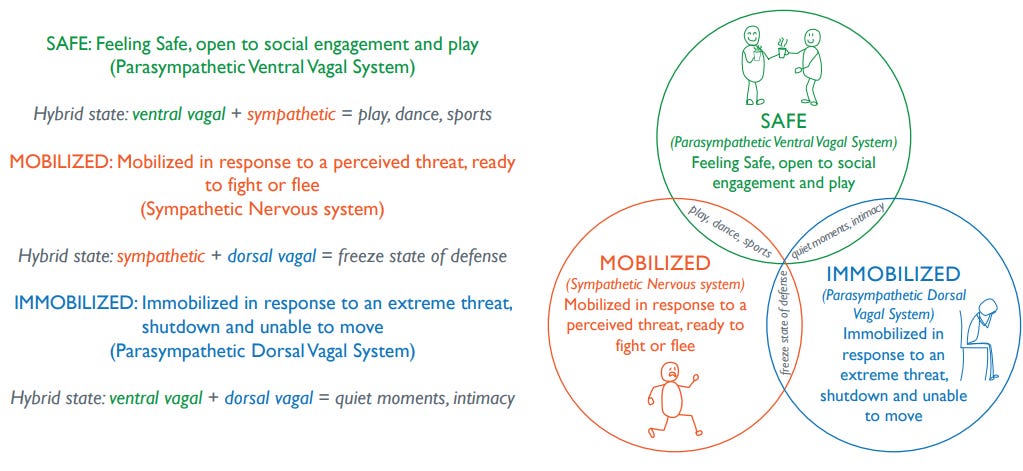
The second organizing principle of Polyvagal theory is called Neuroception, which refers to our scanning of our environment to tell us whether we are safe or not. The third organizing principle is called Co-Regulation, and recognizes that nervous system states are contagious. We want to learn the tools to self-regulate as well as to co-regulate, and we need 50% self-regulation and 50% co-regulation. We need other nervous systems to co-regulate with, and the more high quality co-regulation we get, the more well-being we will feel. High quality co-regulation can look like heart-to-heart communication, cuddles, vulnerability, eye contact, acknowledgement etc. I find this framework useful, as I navigate this time in my life, oscillating between these different nervous system states, and also to recognize that I am in need of co-regulation support.
On Firsts…
In other news, there have been some significant firsts lately…
I ate a piece of chicken a couple of weeks ago, and it was the first piece of chicken I’ve eaten in 10 years. I ended up spontaneously at a small dinner with a professional chef who had prepared a roasted chicken from a small local farm in Ojai.
I was mostly vegan with my former partner for 7 years, but I could not kick my addiction to dairy, even though I had educated myself on the horrors of the dairy industry (which is arguably worse than the meat industry). At the beginning of 2019, I was finally able to ditch dairy and I felt strong and healthy on a pretty strict vegan diet for a solid 3 years. When I moved to Ojai at the beginning of this year, I moved into a special house I spent part of my childhood in, and we had 9 chickens in our backyard. Upon moving in, I began eating their eggs and felt very nourished by the re-introduction of eggs into my diet. I felt such appreciation for the chickens and was in awe that they would literally eat all of our food scraps, and then lay these perfect protein packed eggs in a special little place in their coop. Chickens are amazing creatures, yet as I spent time with them, I began to wonder about the ethics of eating them, and whether I would ever eat them again. I have always said that I don’t think anyone should eat meat if they wouldn’t be willing to kill the animal themselves, and to a degree I still feel this way. Although, then I think about the contrast between someone like my housemate, who has raised and killed animals for food and knows how to do it skillfully, to the horrible painful bloody mess it would be if I tried to do it without that skill set. I wonder about the ethics of being the consumer of the chicken, and leaving the killing of the chicken to the ‘professionals’. Anyway, I surprised myself by eating that small piece of chicken, and it felt like a psychedelic experience. It was also very emotional and disorienting for me, I think because it disrupted who I’ve known myself to be as a vegan, animal lover, and advocate for non-violence.
I have a lot of questions right now about eating animals, some of which have newly arisen and some of which have been swirling around in my brain, things that I haven’t always felt comfortable to share with my carnivorous friends. I do wonder whether eating animals suppresses our natural compassion, and I think of Thich Nhat Hahn’s writings on anger, that anger can be fueled by food that comes from violence. It makes sense to me that the violence in our food directly correlates with the violence in our culture. I also wonder if I ate that piece of chicken because I yearn to feel a deeper sense of connection and belonging with those in my community. What I do know is that I’m confused about it right now, and it feels more complicated than it’s felt in many years. I want to listen to my body, and I wonder how I would feel if I introduced a little fish or chicken into my diet again. I feel morally conflicted about this and if you have any insights or reflections I’d be curious to hear them. I do think we need to be advocating for a mostly plant based diet. I also think we need to be talking about the ins and outs of what it means to eat animal foods much more, and that we can do this from a place that recognizes the nuance and complexity.
Another first recently…I taught my first impromptu yoga class at the studio where I trained a couple of weeks ago. The teacher slotted to sub the class didn’t show up so I decided to step in. It felt wonderful to teach a restorative practice, which has been most of all I’ve been able to do with my shoulder these last weeks, and it has been a beautiful healing practice for me.
On Free Will…
Things are changing, and I feel myself being reconfigured. I’ve come to believe that we don’t have free will, and feel connected to what physicist and mathematician Brian Greene shares in this podcast episode, that “our brains are really good at concocting a narrative to make it seem like ‘we’ are in control…the laws of physics are the ghostwriter behind the scene of our experience.” In this sense, it is all just happening. Adopting this perspective gives me a feeling of peace and helps me to have a greater sense of compassion for people, and for behavior that I might otherwise deem as ‘irrational’. Nothing happens inside of a vacuum, all of life is interdependently woven and we are all a part of the fabric 🙂 We are living in a universe, in which all phenomena is co-arising.
 BRITTANY NEFF